The Shape of the Body
Yuli Junior High School × Tianmei Art Foundation Artist-in-Residence Project: "Myths Starting from the Body (Course A): The Shape of the Body"
In class, I once asked my students, "After you take off your uniform, can I still tell you're a student?"
The student answered very clearly: "No."
At this age, they are already able to understand social identity and power relationships; they know how others perceive them. Not as mature as adults, nor as fragile as children, they say, "We are big friends, not little friends," a meaningful yet somewhat childish statement, like a declaration, a kind of pride unique to junior high school students.
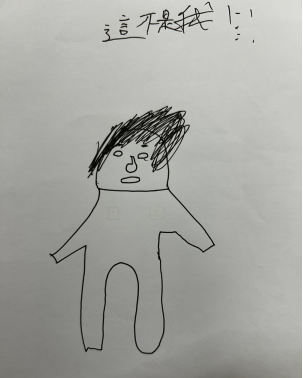
In the first lesson, I gave them a clear instruction: "Draw a body without clothes." I wanted to know what a body would be like to a junior high school student, stripped of all objective information and identity. I also wanted to know how they would perceive the body they drew. After receiving the instruction, the students quietly settled in their corners. Some pondered for a while, some quickly began to draw, while the rest hesitated, looking around anxiously. (Figure 1)

In their depictions of the body, many works linger on the outer contours of the body (head, hands, shoulders, thighs), as if they can only recognize this part as the body and are clearly depicting it. Usually, that is also the first step in depicting the body. It seems that people's understanding of their own bodies always starts from the head. Perhaps it is because junior high school students have undergone a certain degree of aesthetic training, and this system has given them the method to proceed in this way, but it is also possible that they have chosen to draw what they are most familiar with, namely the head.
Perhaps to avoid revealing any connection between the body and themselves, or perhaps because their drawing techniques were insufficient to depict their faces, most of the faces were omitted or erased (Figure 3). Next, brushstrokes linger on the outer contours of the body, from the shoulders to the outer thighs, and then to the soles of the feet. The body's symbols are clearly identified here, and students realize that their next step is to begin drawing the inner contours of the body (inner thighs, breasts, navel). At this point, many students choose to erase these organs and body parts, returning to the previous step to repeatedly draw the outer contours. (Figure 2)(Figure 3)


Some students even draw the edge of their collars into the nude body. That kind of collar, combined with the nude state, makes it look like someone wearing a tight-fitting outfit, or like a layer of skin that can't be peeled off. (Figure 4)

"I know this is not an easy thing."
During the redrawing process, the students covered up the images on the paper, as shyly as if they were covering their own bodies. Although my instruction to them was "draw a body," when you draw a body in the air, it's hard for the reference point not to be yourself. At the same time, you also strongly deny the shame that comes with this connection. Of course, the students were also aware of this (Figure 6). Some students would cover up the inner contours of the body with Polaroid tape when drawing them (Figure 5), and some students would draw blurry mosaics to indicate that this part of the body should not be shown (Figure 7). What surprised me was that at this age when they love to make dirty jokes, their sensitivity to the body was very high, as if they were forming the boundaries of their self, blurry but already taking shape.

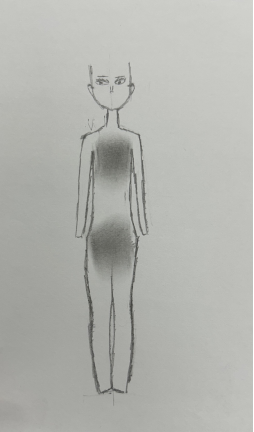
There are also some very candid cases, honestly depicting several questions about their bodies and physical appearances that only develop during puberty. These include images of menstrual blood flowing in the bathroom (Figure 8), patches that may be birthmarks on certain parts of the body (Figure 9), and even primary sexual characteristics such as the growth of body hair and developing breasts, all openly displayed on the body (Figure 10).
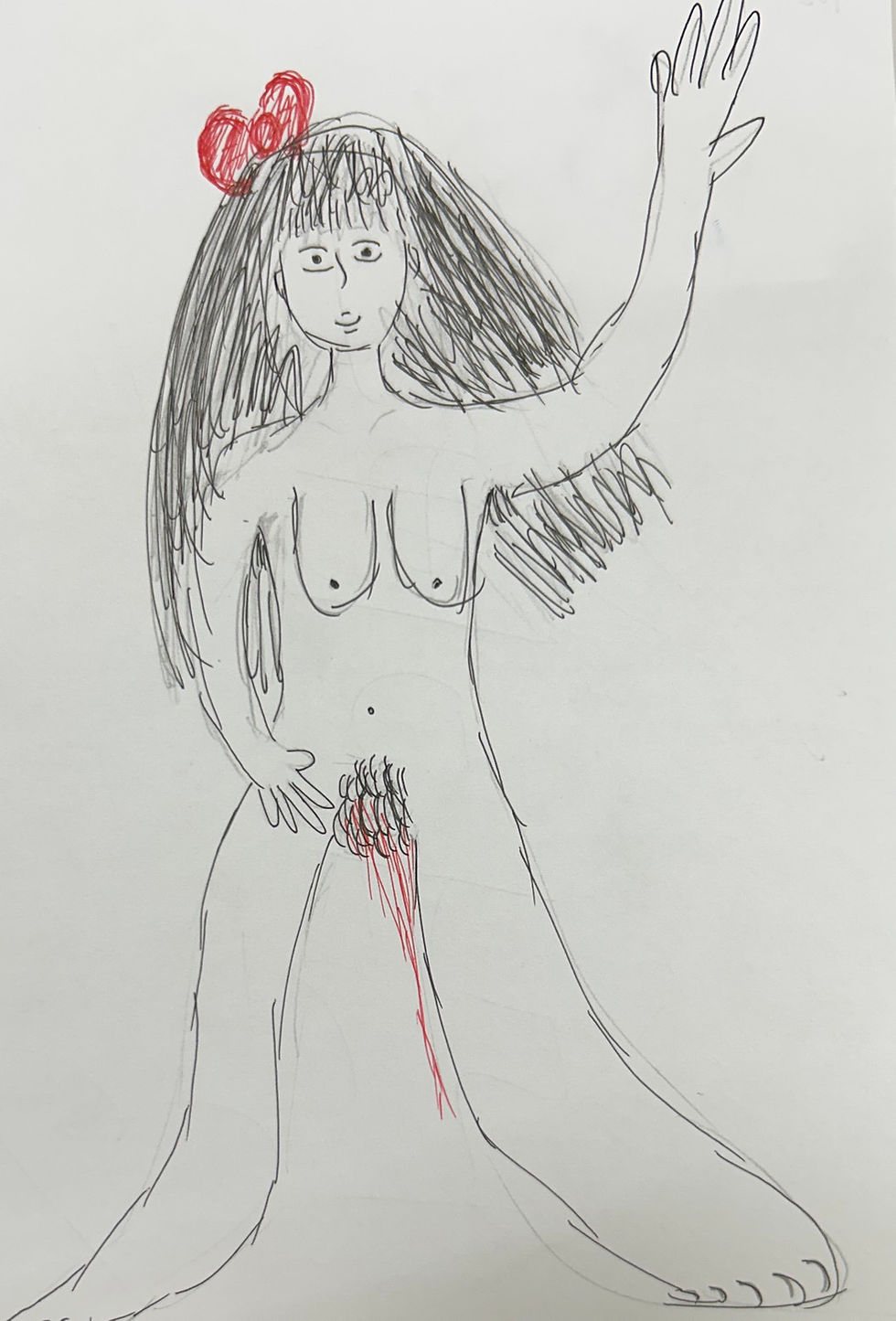


Of course, there were also some body translations and transformations that greatly surprised me. Those sensual contours seemed to be the result of numerous self-dialogues, finally grasping those chaotic bodily masses and outputting them on paper. These bodies were not merely the result of exposure, but also a form of self-interpretation. I was amazed by the powerful ability of students of this age to perceive and express their bodies. (Figure 11)(Figure 12)(Figure 13)
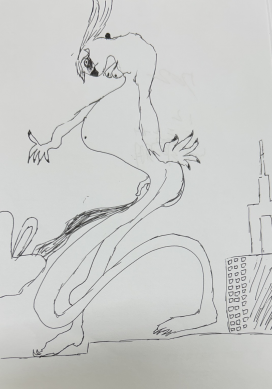


On these sheets of sketch paper, I saw the junior high school students' reinterpretations of the body, including their distrust of drawing techniques and their uncertainty about the body, all forming profound bodily images. When this nude image appeared on the visible surface, the projection of a third-person perspective made them subconsciously cover that surface. It was as if they were indirectly acknowledging the body's reflective posture related to themselves, and this process of projecting themselves onto the artwork was, for me, an anchor point for their self-interpretation in the creative process.
The perspective projected onto their artwork is something junior high school students rarely experience in their regular drawing. When drawing reference objects like anime characters, anime heroes, trains, or insects, they find it difficult to immerse themselves in those objects, focusing more on mastering the form. However, when drawing a human body without reference objects, junior high school students realize that this perspective is no longer just about aesthetic appreciation, but an honest self-communication. By looking directly at themselves and confronting this nakedness, they ultimately output to the interface. In the process, they choose different perspectives, body parts, and shapes to construct an image that illustrates what the body looks like, while also explaining how they view this primal state of being stripped of uniforms and social roles. For junior high school students, the appearance of their bodies has already been clearly inputted into their database, but the outline of their bodies, which is generated out of thin air from within them, is still difficult to output as objective information. The boundaries that prevent them from doing so are still being formed and are blurry. The piece of paper I gave them was like an interface standing on the boundary. In the end, they drew a body without identity on the interface, a form that is beyond objective information and difficult to describe.
Comments